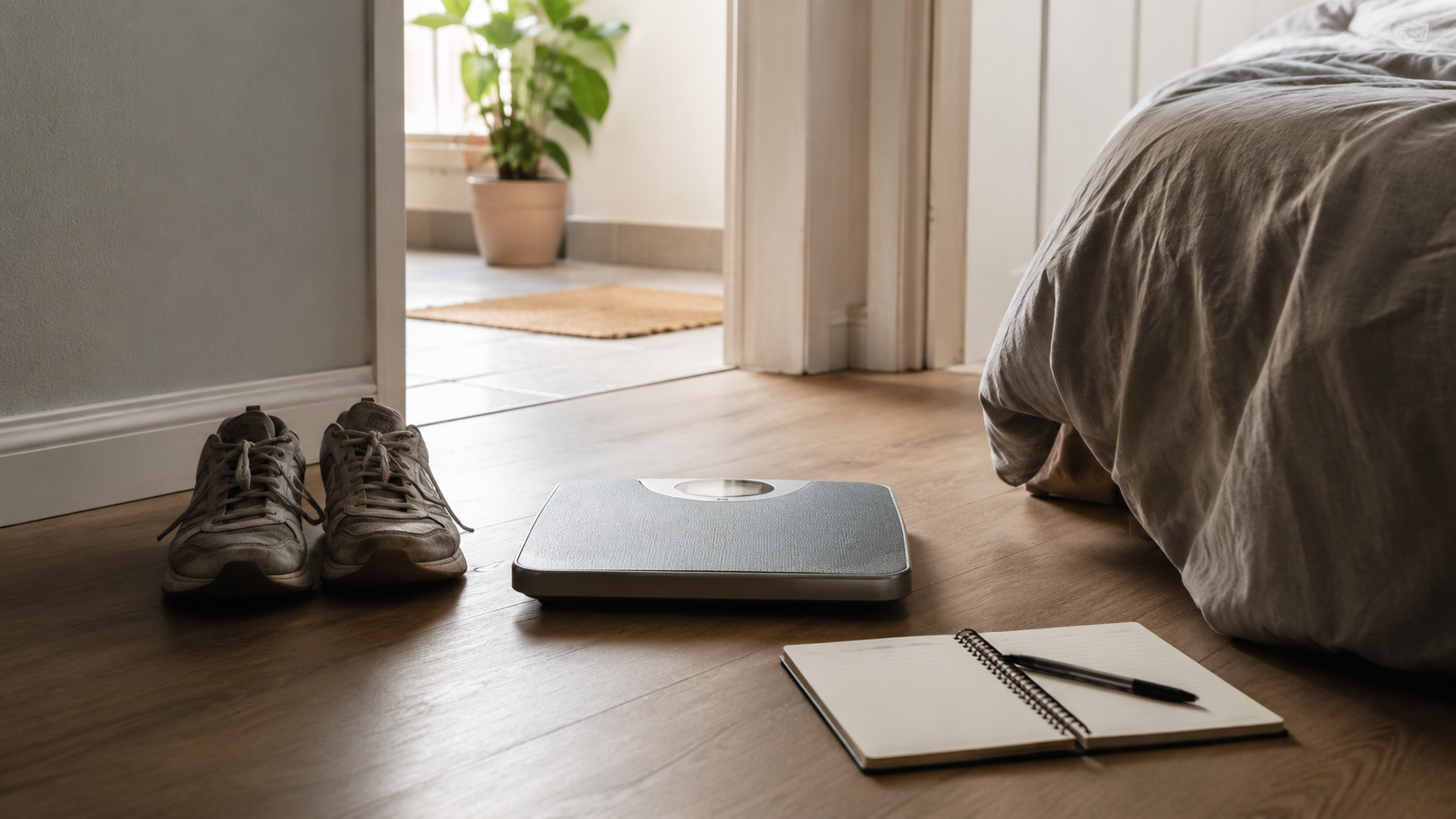
In my first post, I explained why I’m starting a midlife reset at 53.
Before I start changing anything, I want to record where I am now.
Not the version I would prefer to present. Not a carefully edited “before” story written after everything has improved.
The actual starting point.
I am 53, overweight, out of shape and noticeably less fit than I used to be. Everyday things take more effort than they should, and several habits have gradually moved in the wrong direction.
This post is my baseline.
It gives me something honest to look back on later, whether the changes are dramatic, modest or slower than I hope.
My current weight
At the time of writing, I weigh:
- Weight: 234 lb / 106 kg
- Height: 5 ft 9 in / 175 cm
- BMI: 34.5
I know weight and BMI do not tell the whole story. They do not measure fitness, strength, mobility, energy or how somebody feels in everyday life.
But they are still useful starting measurements, particularly because weight loss is one of the reasons I am making these changes.
I may also record:
- waist measurement
- chest measurement
- clothing size
- resting heart rate
- blood pressure, if measured properly
- progress photographs
I have not yet decided how much of that I will publish, but I want to track enough to see what is genuinely changing.
My current fitness level
My fitness is poor.
I get out of breath more easily than I should, particularly when walking uphill, climbing stairs or moving at anything beyond a comfortable pace.
I am not starting from a place where I can casually run several kilometres or complete a demanding workout.
At the moment, realistic fitness looks more like:
- walking regularly
- becoming less breathless on hills
- improving basic stamina
- moving more consistently during the day
- rebuilding strength gradually
- avoiding the usual pattern of doing too much, becoming sore and stopping
I want to measure progress in ways that matter in ordinary life.
That might mean walking the same route with fewer stops, recovering more quickly after a hill, or noticing that stairs no longer feel as demanding.
Those changes would matter more to me than chasing impressive-looking fitness statistics.
Strength and mobility
I have also become noticeably stiffer.
If I sit for too long, particularly on an uncomfortable bench or chair, standing up can leave my back feeling tight or briefly in spasm. It usually eases after I start moving, but it is a clear sign that my mobility and basic strength need attention.
I am not flexible, and I do not currently have a regular stretching or strength routine.
I do have a kettlebell and resistance bands at home, so I may use those as part of a simple routine later.
The priority is not to turn myself into a weightlifter.
It is to become stronger and more mobile in ways that support ordinary life:
- getting up more comfortably
- reducing stiffness
- improving balance
- strengthening my back and core
- moving without worrying that something will seize up
Where pain or symptoms need professional attention, I will treat them as health issues rather than trying to exercise through them blindly.
My current eating habits
My diet is not disastrous every day, but it is inconsistent.
The biggest problems are less about one particular food and more about patterns:
- eating too much
- choosing convenience when I am tired
- snacking without really thinking about it
- eating because food is available rather than because I am hungry
- allowing one poor meal to turn into a poor day
- starting healthy routines and then gradually abandoning them
I am not planning to label food as entirely good or bad.
I also do not want to follow a plan that only works when life is perfectly organised.
The first goal is to become more aware of what I eat, how much I eat and why I am eating it.
That may include keeping a simple food record for a while, improving portion sizes and making a few repeatable meals easier to choose.
Movement during the day
Like many people with desk-based work, I can spend too much of the day sitting.
It is easy to reach the evening and realise I have moved very little beyond walking between rooms.
A workout does not completely cancel out an otherwise inactive day, so I want to pay more attention to general movement as well as deliberate exercise.
That could mean:
- short walks
- standing up more often
- taking movement breaks
- walking after meals
- choosing stairs when practical
- doing a few minutes of mobility rather than waiting for a full workout
The aim is to make movement more normal rather than treating it as a separate event that only counts when I am wearing sports clothes.
Sleep and energy
My energy varies.
Some days I feel reasonably capable. On others, even small tasks feel harder than they should.
Sleep, food, stress, inactivity and weight probably all play a part, although I do not want to assume every problem has one simple cause.
I want to pay more attention to:
- when I go to bed
- how long I sleep
- whether I wake feeling rested
- how energy changes through the day
- whether better routines improve how I feel
I am not expecting perfect sleep every night.
I simply want to stop treating it as something unrelated to everything else.
My current daily habits
At the moment, consistency is probably my biggest weakness.
I can start with good intentions, but those intentions often depend on motivation.
When motivation drops, the habit tends to disappear with it.
That applies to exercise, eating, sleep and most other health-related routines.
So the real challenge is not finding one perfect plan.
It is building a few habits that survive ordinary life.
At the moment, I would describe my routine as:
- too sedentary
- inconsistent with exercise
- reactive around food
- lacking a clear sleep routine
- prone to all-or-nothing thinking
- better at planning changes than maintaining them
That may sound negative, but I find it more useful to be specific than vague.
These are the patterns I need to work on.
What I want to improve
My main goals are straightforward.
I want to:
- lose weight
- become less breathless
- improve strength
- improve flexibility and mobility
- reduce stiffness
- have more energy
- feel better in my clothes
- build habits I can maintain
- feel more capable in everyday life
I am deliberately not setting an ambitious deadline yet.
I want some initial measurements and a few weeks of real experience before deciding what a sensible rate of progress looks like.
What I will track
I do not want this to become a daily spreadsheet obsession.
But without any tracking, it is easy to rely on memory and mood.
For now, I plan to record:
- weight
- waist measurement
- average daily steps
- walking frequency
- basic strength or mobility sessions
- breathlessness on a repeat walking route
- general energy
- notable changes in sleep or appetite
I may change those measures once I understand what is genuinely useful.
The purpose is not to produce perfect data.
It is to notice whether I am moving in the right direction.
This is the baseline
This is where I am starting.
There is no dramatic transformation to reveal yet and no guarantee that everything will go smoothly.
I am overweight. My fitness is poor. My movement is limited, and my habits are inconsistent.
But I now have a baseline.
The next step is to decide what I am changing first—and, just as importantly, what I am not trying to change all at once.
This is my starting point, not a finished success story
I’m recording the reality now so I can judge future progress honestly rather than relying on memory or hindsight.
The next step is deciding [what I’m changing first—and what I’m not].